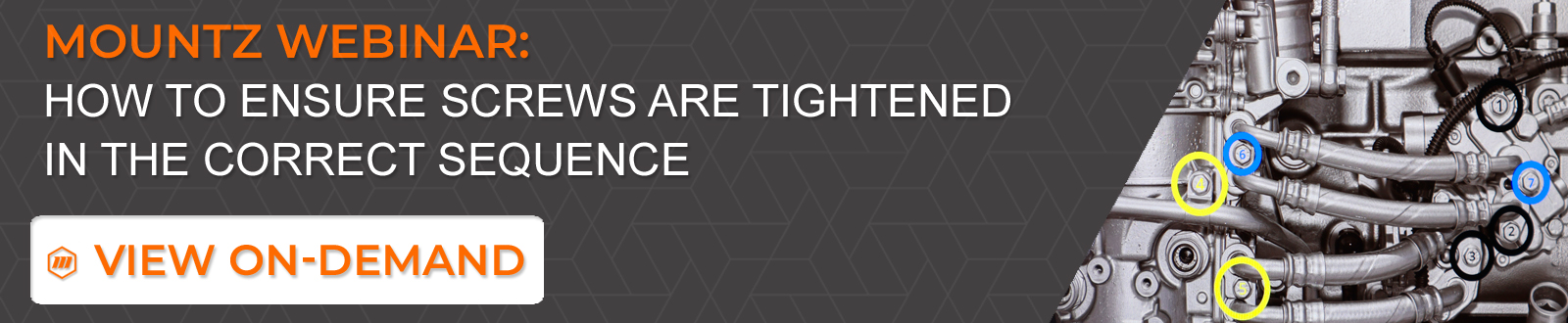
Did you know that an incorrect screw fastening sequence can lead to unreliable results? Using the wrong sequence can cause uneven clamping forces, resulting in joint failure, product defects, and costly rework.
All fastened joints experience some level of relaxation, especially when materials such as gaskets, plastics, or spring washers are involved. Over time, this relaxation can reduce clamping force until the joint stabilizes—making proper fastening sequence critical to maintaining joint integrity from the start.
Sequence-based fastening plays a key role in process control and product quality. The order in which fasteners are tightened directly impacts preload distribution. A well-designed fastening sequence ensures even load across the joint, improving reliability and reducing the risk of failure. To be effective, sequence patterns should always be tested and validated before being implemented in production.
Adding fastening sequence control introduces another layer of error-proofing to your assembly process—helping eliminate rework, reduce warranty claims, and improve overall product quality.
In this webinar, Product Specialist David Cash will demonstrate how to implement a fastening process that ensures all fasteners are installed and tightened in the correct sequence. You’ll learn practical methods to improve visibility, control, and consistency in your assembly operations. Register today to attend the live session and receive the on-demand webinar recording within 48 hours.
What You Will Learn:
- How to ensure correct fastener sequencing in your assembly process
- How to create visual sequence guides using drawings or photos
- Methods for detecting cross-threading, cam-outs, missing screws, and incomplete rundowns
- Techniques for continuous monitoring of the fastening process
- How to monitor and control fastening sequence without complex PLC programming
Featured Products: