



Quick Answer
TBX-Series torque wrenches provide repeatable preset torque using a break-over mechanism that helps prevent over-torque, improve operator consistency, and support quality-controlled fastening applications.
Who This Is For
- Manufacturing & process engineers
- Assembly operators
- Quality engineers
- Electronics, aerospace, automotive, and medical device manufacturers
- Industrial production and regulated manufacturing environments
- CX and Sales teams supporting fastening applications
When Should You Use This?
Use TBX-Series torque wrenches when:
- Repeatable preset torque is required
- Operator consistency is critical
- Over-torque prevention is important
- Multiple operators use the same fastening tool
- Production assembly requires controlled fastening processes
- Quality-system compliance and traceability are priorities
When Should You NOT Use This?
Do not use TBX-Series tools if:
- Torque needs to be adjusted frequently on the production floor
- Bidirectional torque operation is required
- General maintenance or low-volume service work is the primary application
- A lower-cost consumer-grade torque wrench is sufficient
How TBX-Series Torque Wrenches Work
TBX tools use a break-over mechanism instead of a traditional click design.
When preset torque is reached:
- The wrench pivots or “breaks” at the hinge point
- The operator receives a strong visual and tactile indication
- Additional torque application is naturally interrupted
Result:
Improved torque consistency, reduced operator variability, and lower risk of over-torque or fastener damage.
Unlike click wrenches, the break-over action provides more reaction time and physically discourages continued force application.
Core Features
- Preset torque configuration
- Break-over torque indication
- Strong tactile and visual feedback
- Helps reduce over-torque and under-torque conditions
- Interchangeable head system
- Designed for production-controlled environments
- Long calibration life
- ISO 6789 compliant
- ±4% torque accuracy
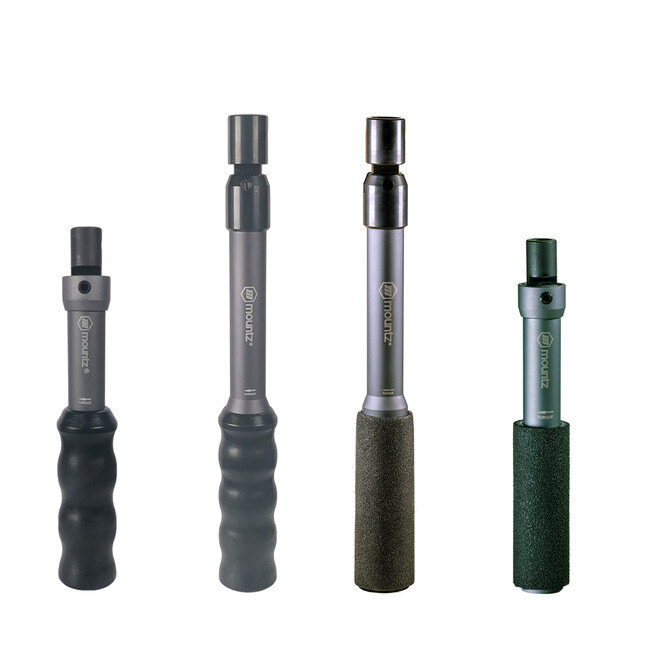
TBX-Series Models
The TBX Series is available in multiple torque ranges to support controlled production fastening applications where repeatable torque and operator consistency are critical.
Each TBX model is preset to a specific torque value within its available torque range and should be verified using a torque analyzer during setup and calibration.
How TBX Models Are Specified
Each TBX model represents a torque wrench family capable of being preset to a range of torque values.
The published range indicates the available torque settings that can be specified during setup or calibration.
Example:
The TBX-25 has an available torque range of 5–25 N·m.
If your application requires 15 N·m, the wrench can be preset and verified at that torque value using a torque analyzer.
TBX Torque Range Lineup
2.4 N·m → 25 N·m
TBX-12 / TBX-12 ESD
[2.4 ─────────────── 12]
TBX-25 / TBX-25 ESD
[5 ─────────────────────────────── 25]
Model Selection Guide
Need lower torque fastening for precision assembly?
Choose:
- TBX-12
- TBX-12 ESD
These models provide a torque range of 2.4–12 N·m (21.2–106.2 lbf.in) and are commonly used for electronics, communications, and precision fastening applications.
Need a medium torque production wrench?
Choose:
- TBX-25
- TBX-25 ESD
These models provide a torque range of 5–25 N·m (44.3–221.3 lbf.in) and are intended for higher torque production fastening applications.
Need ESD-safe fastening capability?
Choose:
- TBX-12 ESD
- TBX-25 ESD
These models are designed for electronics manufacturing environments requiring electrostatic discharge protection.
Need maximum head configuration flexibility?
Choose any TBX model.
All TBX tools utilize interchangeable head systems that support open-end, box-end, ratchet, box ratchet, hex key, fixed square drive, and blank-end head configurations.
Available TBX-Series Models
| Model | Item Number | Torque Range (lbf.in) | Torque Range (N·m) | End Fitting |
|---|---|---|---|---|
| TBX-12 | 076815 | 21.2–106.2 | 2.4–12 | Type A |
| TBX-12 ESD | 076818 | 21.2–106.2 | 2.4–12 | Type A |
| TBX-25 | 076816 | 44.3–221.3 | 5–25 | Type B |
| TBX-25 ESD | 076819 | 44.3–221.3 | 5–25 | Type B |
Interchangeable Head Options / Configuration Options
TBX wrenches utilize interchangeable head systems that allow the tool to be configured for a variety of fastening applications.
Available head styles include:
- Open-End Heads
- Box-End Heads
- Ratchet Heads
- Box Ratchet Heads
- Hex Key Heads
- Fixed Square Drive Heads
- Blank End Heads
Mountz interchangeable heads use a common centerline so torque calibration remains unchanged when swapping head sizes.
Important note:
Head interchangeability is intended primarily for recalibration and configuration—not continuous production swapping.
Type A End Fitting (TBX-12 Models)
Compatible with:
- Open-End Heads
- Box-End Heads
- Hex Key Heads
- Fixed Square Drive Heads
- Ratchet Heads
- Box Ratchet Heads
- Blank End Heads
Type B End Fitting (TBX-25 Models)
Compatible with:
- Open-End Heads
- Box-End Heads
- Ratchet Heads
- Blank End Heads
Which TBX Model Should I Select?
Start with these questions:
- What torque value is required?
- Is ESD protection required?
- Will the wrench be used in a production environment?
- Is preventing over-torque critical to the process?
- What type of interchangeable head is required?
- Are multiple operators using the tool?
- Is repeatability more important than frequent torque adjustment?
- Is a Type A or Type B interchangeable head system preferred?
The answers to these questions will help determine the appropriate TBX-Series model for the application.
Setup & Adjustment
Internal Torque Adjustment
TBX tools use an internal adjustment mechanism.
To adjust torque:
- Set up the wrench on a torque analyzer.
- Use the adjustment hex key to modify the torque setting.
- Verify the torque value using the analyzer.
- Seal the end cap with a calibration sticker after adjustment.
TBX tools do not feature an external torque adjustment scale.
Break Angle Adjustment
TBX-12 and TBX-12 ESD models can be configured for:
- 20° break angle
- 90° break angle
TBX-25 and TBX-25 ESD models utilize a 20° break angle.
Can Torque Be Changed Later?
Yes.
TBX tools can be reconfigured to a new torque setting using a torque analyzer and internal adjustment mechanism. Once adjusted, the wrench should be recalibrated and verified before production use.
Use Cases (Real-World Examples)
1. Electronics Manufacturing
Challenge: Small fasteners are easily damaged by over-torque, leading to stripped threads, cracked housings, or failed assemblies.
Solution: Break-over action helps prevent continued force after target torque is reached
2. Aerospace Assembly
Challenge: Torque inconsistency between operators can cause fastener failures or non-conformances on safety-critical aerospace assemblies.
Solution: Mountz TBX preset torque and break-over indication standardize the fastening process across all operators, supporting AS9100 and process documentation requirements.
3. Medical Device Manufacturing
Challenge: Medical device assemblies require documented, controlled fastening processes to meet FDA 21 CFR Part 820 and ISO 13485 quality system requirements.
Solution: Mountz TBX tools deliver repeatable, preset torque with reduced operator variability, supporting process validation and audit-ready calibration records when used with a torque analyzer.
Troubleshooting
Issue 1: Interchangeable head wear over time
Cause:
Repeated high-cycle use near maximum torque range or poor fastener engagement
Solution:
Inspect heads regularly and replace worn components as needed
Issue 2: Continued force after break-over
Cause:
Operator applying additional load after torque indication
Solution:
Provide operator training and verify correct fastening technique
Issue 3: Torque inconsistency
Cause:
Worn sockets, improper calibration, or side loading
Solution:
Verify calibration and inspect tooling condition
Calibration & Standards
- ISO 6789 compliant
- ±4% torque accuracy
- Calibration life up to 4× ISO standards
- Longer calibration intervals compared to many click-type wrenches
Benefits include:
- Reduced downtime
- Lower recalibration costs
- Improved process stability
Integration / Advanced Notes
- Mechanical torque tool system
- No electronics or data capture
- Clockwise operation only (CW)
- Designed for controlled assembly environments
- Compatible with torque analyzers and calibration systems
Recommended accessories include:
- Mountz EZ-TorQ III Torque Analyzer
- Hex step adapters
- Interchangeable head kits
- Calibration Equipment
Media & Supporting Content
Related Articles / Content
Need Help?
- Contact Applications Engineering for setup guidance
- Speak with Sales for product selection assistance
- Call us:
- North America:(408) 850-9978
- International: +44 1428 741756
- Call us:


 M-F 6am - 5pm PST


